
PUBLIC IMPRESSIONS
Add a Title
Add a Title
recent press...

Fjord Review
"On a program titled “Director’s Choice,” Butler proved a great commissioning pick, if not a surprising one. As Boal put it in his program guide letter to the audience, “Rena Butler is everywhere.” A Q and A with her later in the guide reveals that Butler, a former Hubbard Street Dance Chicago and Kyle Abraham/AIM company member, is currently in such demand that she works on five to eleven commissions simultaneously, and created “Cracks” in four separate week-long studio sprints spread out over nine months. Such a disjointed process doesn’t seem like it would make for a cohesive new ballet, but evidently, Butler knows her prime working methods best. “Cracks” pulls you into an intriguing and emotionally rich world—so much so that, thanks to the instant rewind powers of PNB’s digital season stream, I watched it three times and kept finding new layers to engage with."

Dance Europe Magazine
"The most interesting work was "Persephone" by American choreographer Rena Butler. At only 35, she represents the young generation of the title. On viewing a second cast, I realised that with each new trio it will be a different but equally intriguing work. Butler's inspiration was Bellini's sculpture of Hades abducting Persephone and taking her to the underworld with Cerberus barking at his heels.
Each character is a powerful figure in their own right: Hades as a God, Persephone, the daughter of a Goddess and Cerberus as one of the most terrifying creatures in Greek mythology. Butler investigates the power play between the three, with each configuration highlighting different strengths, and this is brought out with great skill and ingenuity in her intelligent and eloquent choreography.
First cast displayed a fast-moving dynamic with Floor Eimers as Persephone, Potskhishvili as Hades, and Massarelli as Cerberus. The second cast was equally interesting: YuanYuan Zhang, Semyon Velichko, and Edo Wijnen. Both Massarelli and Wijnen got a great deal out of the sly dog, a cunning and unsurprisingly two-faced creature. Hades is a more straightforward tough guy, who gets a great deal of good dance, while Persephone is a smart cookie who plays Hades with much success, but is also caught out by Cerberus's duplicity. The narrative is too subtle and too fast-paced to keep up with, but this doesn't affect the pleasure, as the work remains totally engaging.
Butler has also paid attention to every detail of the packaging. Her intricate blending of music, advised by Jan Pieter Koch, brings Hans Abrahamsen, Dmitri Shostakovich, and Ezio Bosso together in an impressive accompaniment to the drama. Lighting by KJ is dramatic in glaring neons and blinding reds, but complements without distracting. She is certainly a choreographer to watch."
"Butler is a young American choreographer on the rise, and one can see why. Her movement is quite original as she makes the body express itself in intriguing ways — shudders, shimmies, flexes, outthrusts, isolations — a sort of shake, rattle and roll, so to speak. It is also slow and deliberate so the audience can see the body movement in great detail."
"Butler engendered a piece in which the ballet’s dancers share the stage with a live string quartet (Aaron Schwebel, Jamie Kruspe, Joshua Greenlaw and Olga Laktionova) that shifts on its platform across the stage as they play American composer John Adams’ John’s Book of Alleged Dances (1994), creating a spectacle of red-hot, sexy and sassy dance, at once playful and awe-inspiring."
With these two powerhouses teaming up together, Butler and Bias-Daniels say they are betting on an unforgettable show that will leave quite an impression on those in attendance.
“I really want women to see themselves,” says Bias-Daniels. “Maybe what makes me sad will make the next woman happy.”
Butler adds, ”I also hope that men in the audience see it and they’re reflective of how they are helping hold space for women to be big and to be great.”
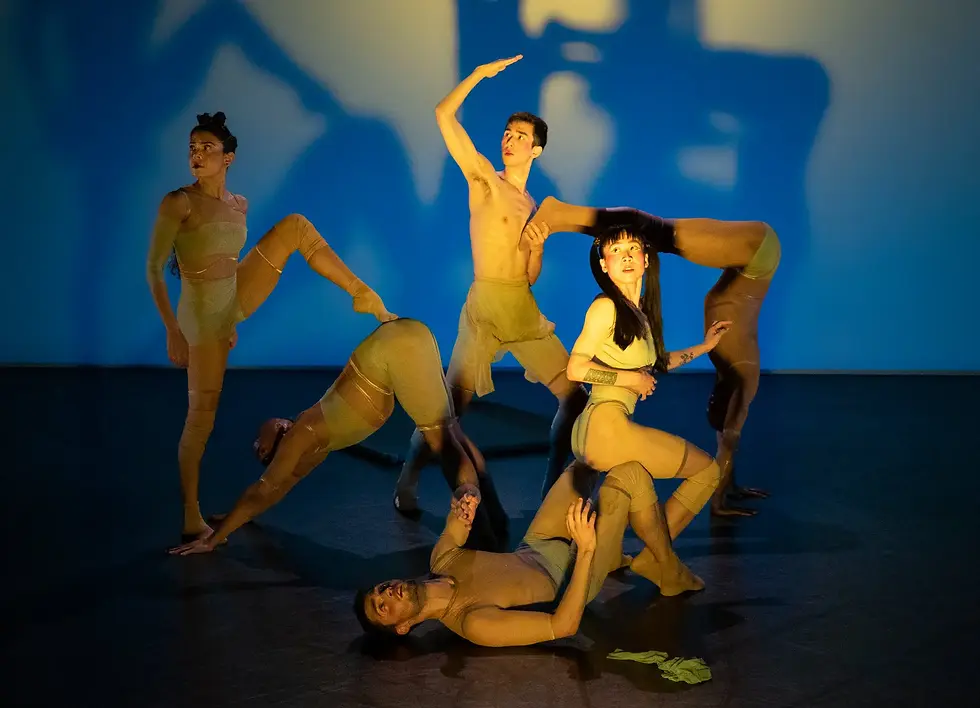
"In her ambitious and thoughtfully assembled 'Re/Build/Construct (Part I),' Butler takes cues from Plato’s 'Allegory of the Cave' to explore how external structures shape internal landscapes and social dynamics. Recorded passages of the text, increasingly warped as the piece progresses, bookend and punctuate Darryl J. Hoffman’s tension-building electronic score. Resembling windup dolls in their robotic yet elastic motion, six dancers deftly manipulate the walls of Tsubasa Kamei’s set. These lightweight panels begin in the form of a house but come apart to create other kinds of boundaries and enclosures."
"Jesse Obremski, in an early solo, is especially uncanny in his puppetlike physicality, an eerie hollowness possessing his eyes and limbs. As they rearrange their world, sparring and conspiring with one another, the dancers periodically erupt in garbled, frustrated speech that feels less fully realized and integrated than other aspects of the work. Movement is the more efficient and expressive language here, right up to the dramatic culmination, which finds the powerful Jie-Hung Connie Shiau trapped within the walls of the reconstructed house — safe shelter turned imprisonment — and ultimately breaking through them."
Siobhan Burke
The New York Times
Review:
"Exploring Plato and Online Dating, Gibney Dancers Give Their All"

Dance Magazine
The Epitome of Contemporary Cool
Zachary Whittaker
"Butler 'knows she deserves to sit at the table even when it doesn’t welcome her,' says Jie-Hung Connie Shiau, a classmate from Purchase with whom Butler overlapped at A.I.M and Hubbard Street before they both joined Gibney Company in September 2020. 'She’s explosive, she covers so much ground, she eats up space. And now, she is able to capture nuance and subtlety and tenderness, as well. That’s something I’ve seen develop in her.'"
"Gibney says. 'This expansion, with Rena, was about seeding leadership into the field. Watching her work is phenomenal because you don’t just see a strong, self-possessed, confident woman at work. You see equity in the process.'"